



QUESTIONS AND ANSWERS ABOUT THE MED WIND PROJECT
Every new project can raise questions, curiosity and concerns.
This page provides a structured analysis of, and response to, the main questions concerning the Med Wind offshore wind farm project.
To support understanding and provide complete information, the page includes concise answers as well as additional details on the more technical aspects, supported by scientific studies for which sources are provided.
Med Wind represents a unique opportunity for Sicily and Italy to contribute to the energy transition, strengthen independence from third countries, create new jobs and, at the same time, protect the marine environment, while ensuring navigation safety and respect for biodiversity.
If you have any further questions, please do not hesitate to contact us: info@renexia.it
1. Will the Med Wind wind farm be visible from the Sicilian coast and the Egadi Islands?
The turbines will be practically invisible to the naked eye.
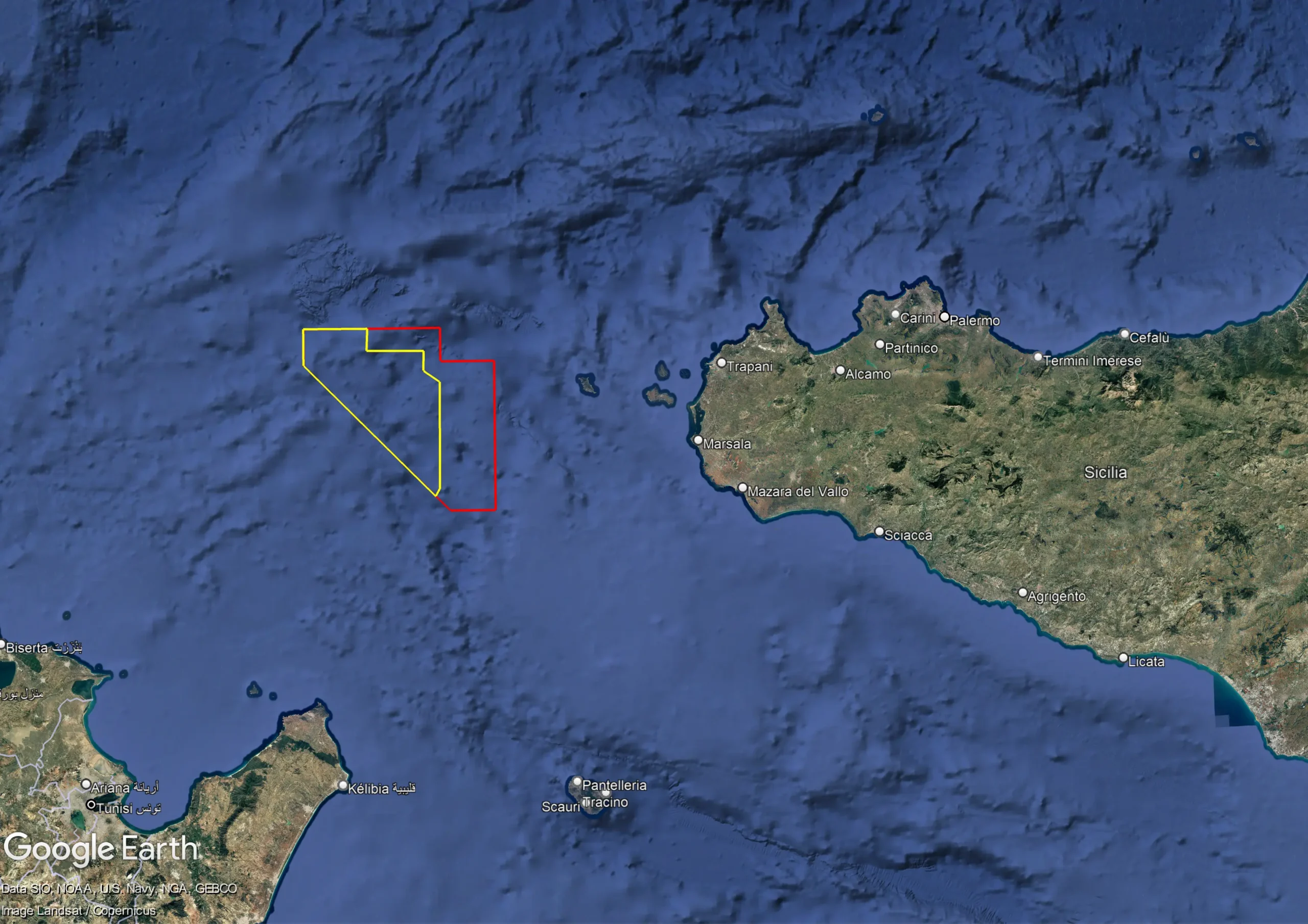
The wind farm will be located more than 47 km from the Egadi Islands. At this distance, due to the Earth’s curvature and atmospheric factors, the turbines will be practically imperceptible.
Distance of the wind farm:
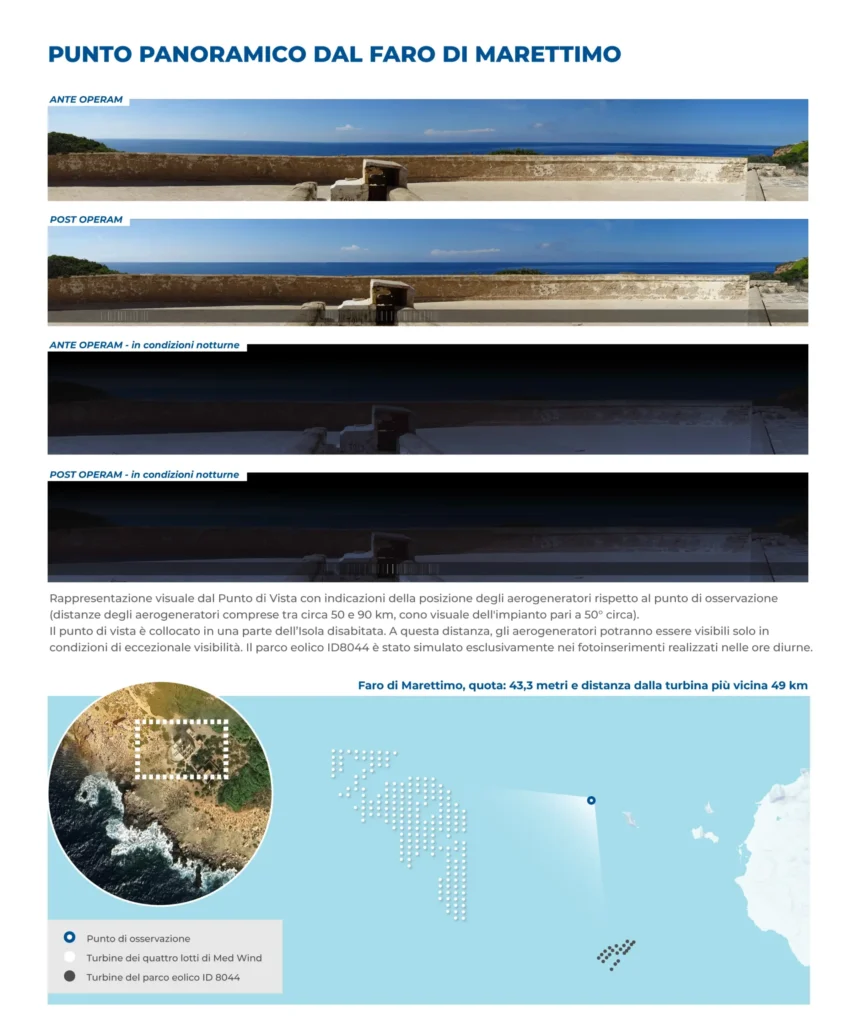
The landscape impact assessment is based on rigorous analyses that take unavoidable physical factors into account. At distances greater than 40 km, the visibility of complex objects such as wind turbines is drastically reduced. The Earth’s curvature naturally hides the base and a large part of the structure, while marine haze reduces contrast and sharpness to the point that the object becomes indistinguishable from the background.
The photomontages and analyses contained in the Environmental Impact Assessment confirm that the turbines will not be visible from any observation point along the coast. The percentage indicated by the theoretical intervisibility map refers to the potential visibility of the wind farm. However, this map does not take into account all the factors that help reduce the visual impact, such as the Earth’s curvature, haze, the human eye, and so on.
The study applies a standard and transparent methodology, based on Potential Visibility and Theoretical Perception of the Facility, which demonstrates, precisely through physical calculations, that the wind farm will either not be visible or will have an extremely low level of perceptibility.
- Visual Impact Study by RINA:
- From the “Marettimo – Lighthouse” viewpoint, at a distance of 49 km, perceptibility is possible only under conditions of “exceptional visibility”, and the Theoretical Perception of the Facility is classified as “Very Low”.
- From the “Favignana-Monte” viewpoint, at a distance of 72.5 km, the visibility of the nearest blade under exceptional conditions has a Theoretical Perception of the Facility classified as “Very Low–Nil”.
- From the island of Levanzo, the Theoretical Perception of the Facility is classified as “Nil”.
- From the Marsala viewpoint, at a distance of 83 km, perception is “Nil” and the impact is “Negligible”.
- International studies: The visibility of offshore wind turbines is already considered very limited beyond 30–40 km. The maximum documented distance under perfect conditions is approximately 58 km.
1 Environmental Impact Assessment and Visual Impact Study prepared by RINA for the Med Wind project and filed with the Italian Ministry of the Environment and Energy Security.
2. Will the offshore wind farm have an impact on migratory bird routes and avifauna?
The main migratory flows occur at a great distance from the wind farm. In addition, the adoption of advanced mitigation measures, together with the wide corridors between the turbines, will allow safe passage.
The impacts on avifauna have been assessed as not significant. The large distance between turbines and the adoption of advanced mitigation measures reduce collision risk and the barrier effect to minimal levels.
SHUTDOWN ON DEMAND
Temporary shutdown of the blades in the event of large flocks being detected by radar.
Continuous monitoring of avifauna using cameras.
outside the main migratory corridors
guaranteeing ample space for transit
of collision
with a very low collision risk
2 Habitat Regulations Assessment – Appropriate Assessment.
3 Habitat Regulations Assessment – Screening – Level 1.
3. Could noise and construction works for the Med Wind project harm cetaceans and marine fauna?
NOAA, the National Oceanic and Atmospheric Administration, and BOEM, the Bureau of Ocean Energy Management, confirm that there is no scientific evidence linking offshore wind farms to strandings.
Reduced operational noise:
Scientific studies:
Continuous monitoring:
Non-sensitive areas:
During the operational phase, the noise produced by the turbines is continuous and low-frequency, comparable to marine background noise or the transit of a small number of vessels, and well below damage thresholds for marine fauna.
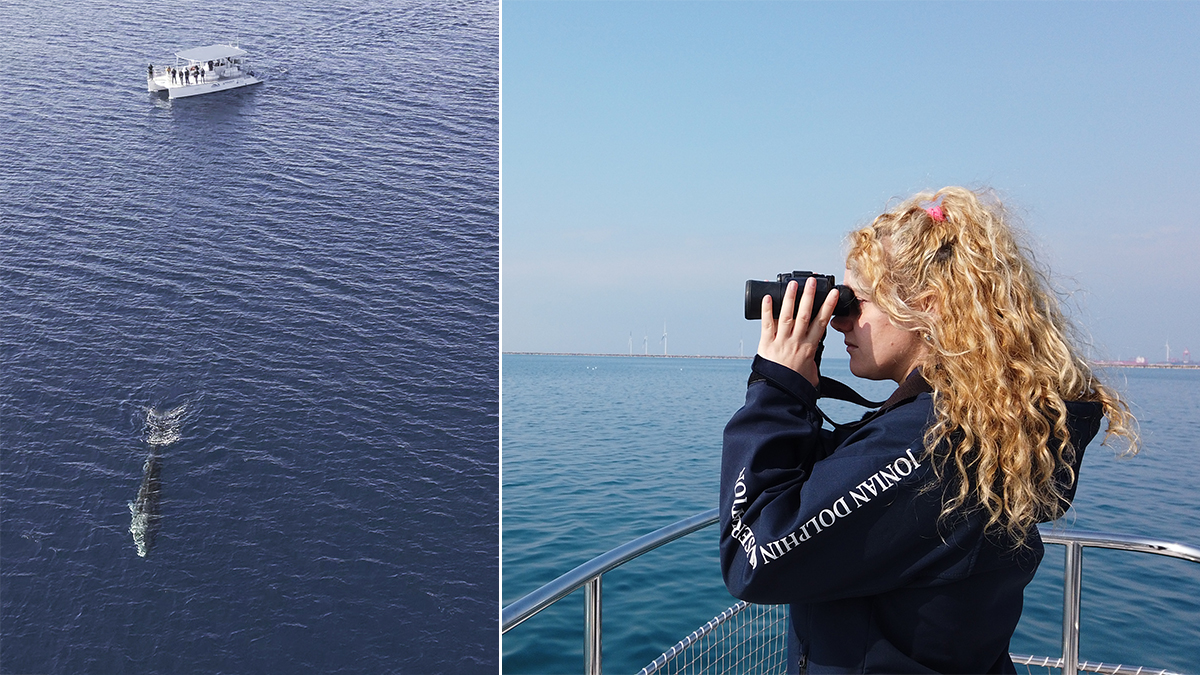
The surveys carried out, including visual and acoustic monitoring, confirmed only an occasional presence of cetaceans, including dolphins and pilot whales, and the absence of areas of strategic importance for their survival. International scientific bodies such as NOAA, the National Oceanic and Atmospheric Administration, and BOEM, the Bureau of Ocean Energy Management, confirm that there is no evidence linking offshore wind farms to stranding events, and that the main anthropogenic threats to cetaceans remain collisions with vessels and fishing nets.
The acoustic modelling carried out using a conservative approach demonstrates that the sound sources associated with the different phases of the project, including anchor installation, turbine positioning, cable laying and turbine operation, generate only continuous low-frequency noise, without impulsive components, and are fully masked by the ambient noise already present in the Sicilian Channel, which is dominated by international maritime traffic with average levels between 120 and 140 dB re 1 μPa. The project includes an Environmental Monitoring Plan that provides for the presence of specialised Marine Mammal Observers during construction works and continuous acoustic monitoring during the operational phase to verify compliance with limits. For loggerhead sea turtles, Caretta caretta, for example, the analysis estimated that construction activities will cause negligible disturbance and that, during operation, turtles will not suffer consequences, as they will be able to swim freely between the structures.
4 NOAA, National Oceanic and Atmospheric Administration – Studies on the impacts of offshore wind on marine mammals.
5 BOEM, Bureau of Ocean Energy Management – Environmental assessments for offshore wind farms.
6 Environmental Monitoring Project – PMA.
7 Predictive Modelling Study of Underwater Noise.
8 Environmental Impact Assessment.
4. Will the structures damage marine biodiversity?
The area will become a protected zone where habitats can regenerate.
The surveys revealed seabeds damaged by decades of illegal bottom trawling. The project area was reduced in order to avoid sensitive areas. The exclusion of fishing will create a fish repopulation area.
2,500 km² → approx. 1,000 km²
LOW-IMPACT TECHNOLOGY
Seabed footprint
Minimal and reversible
POSITIVE EFFECT
Stop to bottom trawling
for habitat regeneration
REEF EFFECT:
Demonstrated increase in biodiversity
and fish abundance
The environmental surveys, carried out using advanced technologies such as ROVs, Remotely Operated Vehicles, multibeam echo sounders and direct sampling, revealed a seabed damaged by decades of illegal bottom trawling, with the destruction of vulnerable biocoenoses such as coral gardens and sponge aggregations.
In addition, the environmental campaigns documented the widespread presence of anthropogenic waste on the seabed, including abandoned nets, plastics and metal residues. Thanks precisely to this mapping, the project was modified to avoid sensitive areas.
The physical footprint of the facility on the seabed is minimal and limited to anchoring points that do not require cementing. The exclusion of bottom trawling from the area will create a “no-entry zone” that will function as a fish repopulation area. This phenomenon, known as the “reef effect”, or artificial reef effect, is well documented in other offshore wind farms around the world.
The submerged structures, including anchors and cables, will become a substrate for the settlement of benthic organisms such as mussels, anemones, polychaetes and sponges, increasing local biodiversity and creating a secondary habitat with high biological density. Studies in the North Sea have documented an increase in the abundance of fish species such as cod and wrasse around turbines.
9 Environmental Impact Assessment prepared by RINA for the Med Wind project and filed with the Italian Ministry of the Environment and Energy Security.
5. Will fishers lose fishing areas?
The project area is located more than 80 km from the coast and was also identified on the basis of existing usage patterns. A permanent technical working group with the fisheries sector is active in order to define shared solutions.
ECONOMIC COMPENSATION
Direct compensation and support for fleet modernization.
SPILLOVER EFFECT
The ban creates a marine reserve that increases biomass in surrounding areas.
PLASTIC COLLECTION
TRAINING AND EMPLOYMENT
Professional retraining and employment in activities supporting the wind farm.
LOCAL COMMUNITY FUND
A dedicated share of resources is allocated to supporting local communities, including the fishing sector.
AGREEMENTS WITH REPRESENTATIVES
Agreements with trade unions to support the sector in a structured manner.
The wind farm area is located more than 80 km from the coast, in a zone used only to a limited extent by Sicilian fishing fleets, which operate mainly in more coastal waters and at shallower depths. For potentially affected fishers, dialogue and compensation measures were activated from the outset.
Renexia has launched a technical working group with the fisheries sector, defining agreements that include:
- Economic compensation for loss of access to the area.
- Support for fleet modernisation, such as contributions for new engines or activity diversification.
- Investments in port infrastructure, including the electrification of quays to provide green energy to moored boats.
- The involvement of fishers in paid activities to clean plastic from the sea.
In addition, the fishing ban within the wind farm will create a fish repopulation area, or reserve effect. The increase in fish biomass within the protected area will generate a “spillover” effect, enriching neighbouring fishing areas with fish and bringing benefits to yields in the medium to long term. Studies in the North Sea have found that around turbines the abundance of certain fish species, such as cod and wrasse, has increased thanks to the artificial reef effect and the cessation of fishing.
10 Socio-Economic Impact Study prepared by Deloitte for the Med Wind project and filed with the Italian Ministry of the Environment and Energy Security.
6. Will the wind farm block maritime routes?
The project does not interfere with the main routes and complies with international standards.
The wind farm will be located far from the main commercial and tourist routes, which pass south of the project area.
Each turbine will have lights and markers compliant with IMO, International Maritime Organization, standards in order to ensure the highest level of safety.
After the wind farm enters operation, maritime traffic will be redistributed along different corridors.
FAR
from the main commercial
and tourist routes
MARINE TRAFFIC ANALYSIS
low shipping
density area
COMPLIANCE
WITH IMO SAFETY STANDARDS
light signals, radar, and publication on nautical charts
BUFFER ZONE:
physical separatio
from shipping lanes
PROVEN INTERNATIONAL EXPERIENCE:
safe coexistence of wind farms
with heavy traffic in Northern Europe
The risk of vessel-turbine collision has been assessed as extremely low. During construction, notices to mariners, NAVTEX, will be issued to provide advance information and coordinate navigation.
11 Navigation Risk Study prepared by RINA for the Med Wind project and filed with the Italian Ministry of the Environment and Energy Security.
7. Will the turbines release microplastics and toxic substances?
Modern blades are made of composite materials designed to withstand the marine environment for decades.
Erosion is a known but minimal phenomenon, countered by high-tech protective coatings, known as Leading Edge Protection.
BISPHENOL A (BPA)
LEP COATINGS
FUTURE RESEARCH
Compared to marine microplastics
PERCENTAGE CONTRIBUTION:
A Dutch study estimates the contribution of wind power at 0.0005% of total microplastics.
COMPARISON:
A single wash of synthetic clothes can release tens of grams of microfibers, an amount comparable to that released by a single blade in a year. Tire wear disperses millions of tons of plastic particles globally every year.
12 Caboni, M. et al. (2025). “Microplastic emissions from wind turbine blades”. Wind Energy Science (WES), 10, 1123-1138.
13 Mishnaevsky Jr., L. (2024). “Environmental aspects of wind turbine blade coatings”. Energies, 17(24), 6260.
14 Bedulina, D. et al. (2024). “Microplastic release from offshore wind infrastructure”. Science of the Total Environment.
15 Hildebrandt, L. et al. (2024). “Assessment of microplastic emissions from wind energy systems”. Marine Pollution Bulletin.
16 Dutch government-commissioned study on contributions to microplastics, estimating a 0.0005% contribution for wind energy.
8. Will the facility bring economic benefits only to a foreign company?
Med Wind will generate significant direct and indirect economic impact for Sicily and Italy. The construction and maintenance of the wind farm will require specialised local labour, port services and advanced logistics.
For 6 years (construction)
LOCAL IMPACTS
Involvement of the Port of Augusta;
agreements for local training and employment;
For 25 years
(maintenance)
Estimated increase
for sustainable development initiatives.
The estimated total investment amounts to approximately €9.5 billion, of which €7 billion in Italy and approximately €3.2 billion in Sicily. These investments will enable the creation of jobs requiring highly specialised labour. In addition, a continuous workforce presence will be required throughout the facility’s life cycle, approximately 30 years. Indeed, over these 30 years, approximately €8 billion of investments have been planned, of which €7.6 billion will be in Italy, including €2.5 billion in Sicily.
Agreements have been signed with the Sicilian Region and trade unions, including CGIL, CISL, UIL and UGL, to maximise the employment of local labour through dedicated training programmes aimed at creating new skills in the offshore wind sector, such as underwater technicians and offshore maintenance operators.
A foundation with an endowment of €180 million has been planned to finance sustainable development initiatives in the territory, benefiting local communities through economic reconversion, sustainable tourism and the enhancement of coastal communities.
The energy produced, almost 9 TWh per year, equivalent to the needs of 3.4 million households and to 3% of Italian electricity consumption, will be fed into the national grid, contributing to the country’s overall energy security and to stabilising bill costs, with an indirect benefit for all citizens and businesses, including those in Sicily. The project will avoid the emission of approximately 2.7 million tonnes of CO₂ every year.
17 LUISS University and Deloitte – Socio-economic study on the Med Wind project.
9. Are floating turbines safe in the event of a storm?
Yes. They are designed to withstand extreme marine conditions for more than 25 years.
Floating turbines are designed according to rigorous international standards, such as DNV and IEC, and tested under extreme conditions. The technology is already successfully operating in Scotland, Japan, France, China, Spain, Portugal and Norway, with proven results. The anchoring systems are sized to withstand waves of up to 20 metres and winds above 200 km/h.

Certification

Globally validated technology
10. Why install a wind farm specifically in Sicily?
UNIQUE WIND RESOURCE
Constant and productive wind, impossible to replicate elsewhere in Italy.
FLOATING
ENERGY HUB
18 Socio-Economic Impact Study prepared by Deloitte for the Med Wind project and filed with the Italian Ministry of the Environment and Energy Security.
11. What will happen to the facility at the end of its life?
Complete decommissioning is guaranteed and technically straightforward.
Unlike oil platforms or fixed-bottom offshore wind turbines, floating turbines are not cemented to the seabed. At the end of their life, they are simply disconnected from the anchors and towed to port for dismantling and recycling. At the end of approximately 30 years of operation, the wind farm will be fully decommissioned and most of the materials will be recycled. The marine seabed will be restored and may benefit from an ecologically richer environment, thanks to the prolonged presence of a biomarine protection area that will have supported biodiversity and ecosystem regeneration.
SIMPLE REMOVAL
No complex underwater demolition. Unhooking and towing (Reverse Installation).
FINANCIAL GUARANTEE
Bank guarantee deposited before the start of works to cover removal costs.
CIRCULAR ECONOMY
Recovery of steel, copper, and composite materials for new production.
COMPLETE RESTORATION
19 Decommissioning Report prepared by RINA for the Med Wind project and filed with the Italian Ministry of the Environment and Energy Security.
Find out more
All technical documentation, environmental studies, and project updates are publicly available.